

Gluteus Minimus Exercises are often overlooked but they’re key for hip stability, balance, and injury prevention. This small muscle plays a big role in how you move, and when it’s weak, you’ll feel it in your hips, knees, or lower back. Adding targeted glute exercises helps improve strength and overall movement.
"Always looking for new exercises and this list is great! Such an important party of the body to work out. Used it this morning and felt so good after. Thanks for the great article!" - Bridgette
A Quick Look At The Exercises
- 🎯 Best For: Hip stability, better balance, and reducing hip/knee/low back pain
- 💪 Exercises Included: 15 moves targeting the often-ignored third glute muscle
- 🏋️ Equipment Needed: Bodyweight, or add a mini band for more resistance
- 🔁 How To Use This: Pick 4-5 moves for a quick, focused glute workout
- 🧠 Key Takeaway: Your glutes are 3 muscles, not 1, skipping this one limits real strength progress.
- ⭐ Why You'll Love It: Better balance and stability you'll actually feel in daily movement
SUMMARIZE & SAVE THIS CONTENT ON
Glute training is getting more attention (finally), but most people still focus only on gluteus maximus exercises like bench glute bridges, aka hip thrusts.
The problem? Your glutes are made up of three muscles, and if you’re not training them all, you’re leaving strength, stability, and results on the table.
To build strong, functional glutes (and actually feel them working), you need to train them in multiple planes, not just up and down.
What Is The Gluteus Minimus (And Why It Matters)
The gluteus minimus is the smallest glute muscle, sitting beneath the glute medius. Its main role is to stabilize your hips, especially when walking, running, or standing on one leg. This is why unilateral exercises are so important.
Because of this, it plays a huge role in balance, coordination, and helping prevent hip, knee, and lower back pain. It also supports overall glute strength, since all three glute muscles work together during movement.
Best Gluteus Minimus Exercises
While many lower body exercises (like glute bridges, squats, and deadlifts) engage the glutes, the exercises below place more direct emphasis on the gluteus minimus.
- Side-lying hip raise
- Side lying hip abduction (regular and extended range)
- Lateral lunges
- Sumo walks
- Seated band abductions
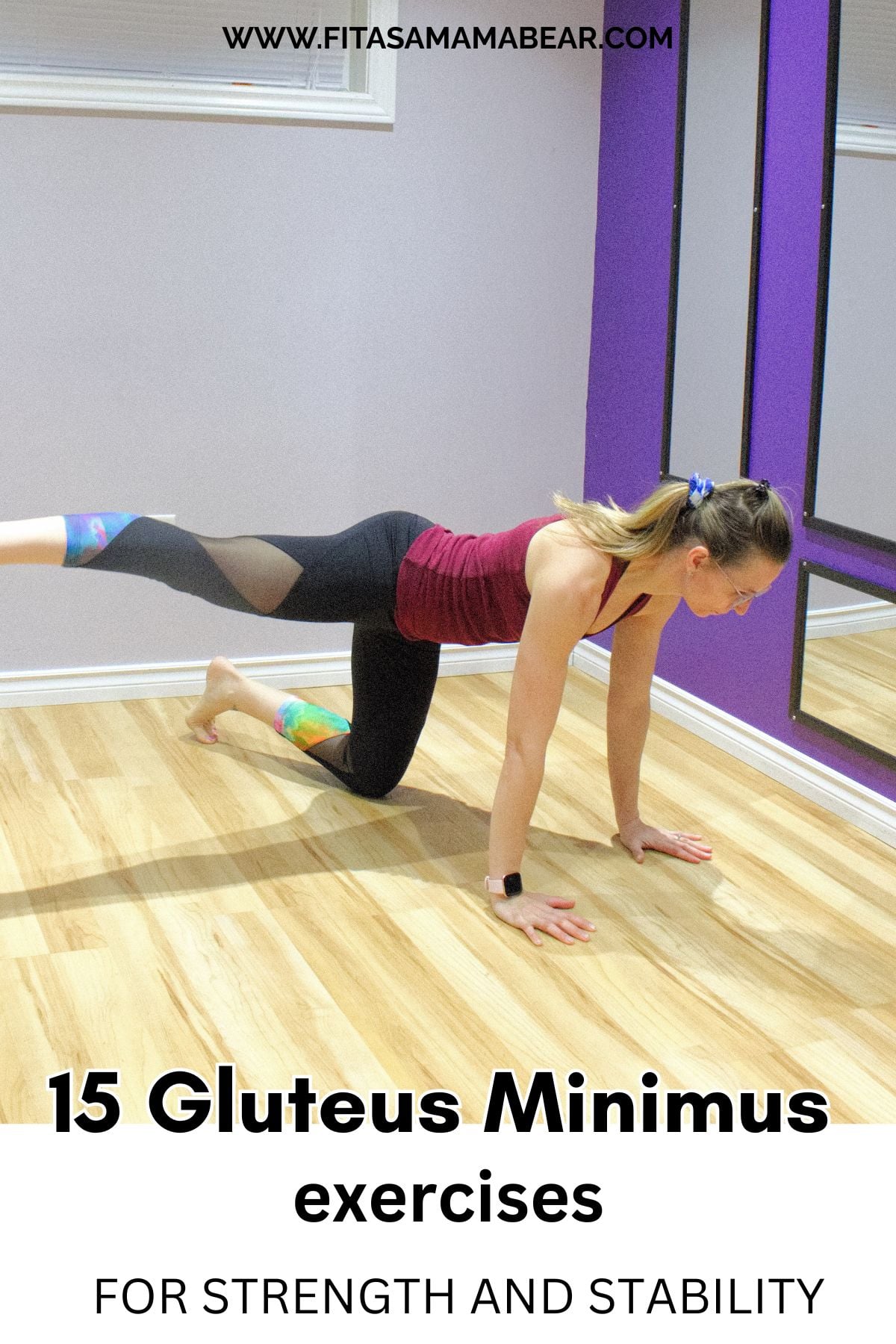
- Quadruped hip abductions
- Glute march
- Curtsy lunge
- Single leg elevated bridge
- Fire hydrant
- Standing bent knee abduction
- Deficit lunge
- Single leg hip thrust
- Side plank dips
- Standing bent knee abduction
Important: Lots of smaller exercises like hip hikes, wall airplanes, etc will target the gluteus minimus. This list primarily focuses on single-leg exercises that target balance and stability to recruit the muscle.
Exercise Tips
Use the exercises below with intention; don’t rush through them. Focus on control and actually engaging your glutes (learn how to engage glutes).
Pick 4–5 moves to create a quick workout, or add a few into your current routine. This is how I program glute training inside my Glute Guide, so you’re building strength consistently.
You can do these with bodyweight, but adding a mini band (loop) is the easiest way to increase resistance and see better results (check out these other mini band exercises).
1. Side Lying Hip Raise
This glute exercise targets both the core and your glute muscles forcing them to work together to get stronger.
How to perform it:
- Lay on your right side with your knees bent and feet together. Hips and shoulders in one line and the right arm under the right shoulder.
- As you raise up into side plank position and lift the hips off the ground, raise the top leg up using the left glute. Keep the knee bent and flex the left foot. Pause and return to the starting position.
reps: 10-15 repetitions.

2. Extended Range Abduction
Taking abductions to a whole new level by adding a bigger range of motion to double up on strength.
How to perform it:
- Lying on your right side on a bench (or table etc), bend your bottom leg so it’s out of the way. Keep the left leg straight and let it dangle off the bench while having your thighs together.
- Lift the left leg from the “deficit” position against the band. Pause at the top and return it to the start position.
Reps: 20 repetitions per side.

3. Lateral Lunges
These lunges target the glute in every rep and can be done with a variety of weights and ways as you progress.
How to perform it:
- Stand upright.
- Step out to the side with your left foot.
- Push the hips backward and sink them down while keeping the heel on the floor.
- Pause briefly.
- Push up through the foot to extend the hip and bring the foot back into the starting position.
- Perform all the repetitions on one leg before moving on to the next.
Reps: 8-10 repetitions per leg.
4. Quadruped Band Hip Abductions
Anything in the quadruped position forces your core and glutes to work together to stabilize during movement. This exercise magnifies that as the glutes have to work to do the movement as well.
How to perform it:
- For this exercise, you’ll need to anchor a strength band. This can be done on a beam, a deck post, or with a dumbbell placed behind a door.
- Come into table top position and hook the strength band onto the left foot which is furthest from the anchor point.
- Engage the core for a stable back and keep the left leg straight, move the foot away from the body at hip height.
- Pause briefly and return the it to the center position.
Reps: 15 reps per leg.
5. Curtsy Lunge
Lunges already target the glutes as a whole but curtsy lunges take that stress even further and focus more on the gluteus minimus.
How to perform it:
- Stand upright in a comfortable position. Step the left foot back and across the line of the right leg. Lower the knee toward the floor while hinging slightly at the hips. Keep the foot of the right leg fully on the floor.
- Push through the right foot and return the left foot back to a standing position.
Reps: 8-12 repetitions per leg.

6. Single Elevated Leg Bridge
Single leg training means that one side can't take over for the other. This bridge variation is a great way to reduce injury risk.
How to perform it:
- Lay on the ground with your heels elevated on a couch, stairs or bench.
- Raise your right foot into the air.
- Push through the left foot and lift the hips high without excessively arching the low back.
- Pause and return the hips toward the floor.
- Perform all the repetitions on one leg before moving onto the next.
Reps: 10-15 repetitions per leg.

7. Glute March
Stability and strength in this glute exercise. The addition of a band provides tension.
How to perform it:
- Laying on the ground on your back, bring the heels close to the bum. Raise the hips into a glute bridge position. Keeping the glutes squeezed and the hips squared, begin walking each foot out away from the bum.
- Walk the feet out until you can no longer support the low back or the hips and then walk them back into the bum again.
Reps: 30-45 seconds.
8. Fire Hydrant
Another one in the quadruped position, with fire hydrants the glute must active work to raise the leg through a large range.
How to perform it:
- In a tabletop position, place the band below the knees.
- Maintain core engagement and try not to twist the hips as you cock your leg (keeping the knee bent at ninety degrees) out to the side against the band.
- Pause and return the knee to the starting position. Perform all reps on one side before moving to the next.
Reps: 30 seconds per leg.
9. Deficit Lunge
Increasing the range of motion in a lunge and the ability required to perform it means more stress on the smaller glutes. This is one of the best lower glute exercises.
How to perform it:
- Using a bottom step or yoga blocks, stand upright, chest lifted, on the step.
- Step the left foot back onto the floor and begin bringing the knee down towards the floor as you hinge the upper body forward slightly.
- Pause at the bottom and then reverse the movement and pull up your body with the right leg (don't push off the left foot!), extending the hips back into a standing position.
Reps: 8-12 repetitions per leg.

10. Single leg hip thrust
A great one to train unilaterally to get stronger. Learn more about unilateral exercises and how they reduce injury risk.
How to perform it:
- Set up in hip thrust position with your back on the bench (running roughly along your bra strap) and the left knee bent and over the heel. The right leg will be raised.
- Dip your hips towards the floor making sure that the left knee stays facing forward and not caving. Squeeze the glutes and lift the hips towards the ceiling while squeezing the glute.
- Your back will extend flat on the bench. Lockout the glute briefly, release the tension, and return to the starting position.
- Perform all repetitions on the left leg before moving on to the right leg.
Reps: 8-12 repetitions.

11. Sumo Walks
My favorite exercise for a glute finishers, because they require stability in one glute and strength in the other. I use them in workouts like this glute HIIT workout, and they burn so perfectly.
How to perform it:
- Standing upright you can place the band around the top of the knees, below the knees or over the shoelaces for different tensions.
- Hinge forward slightly keeping your weight pushed backward and a flat back. Stand on one foot as you move the other foot sideways using your glutes to push against the band.
- Step down and continue this process one way before completing the same motion on the other side.
Reps: 30-45 seconds.

12. Side Plank Hip Dip
Similar to the hip raise but this time with a longer level for more challenge.
How to perform it:
- Set up in side plank position with your elbow under your shoulder and feet stacked.
- Raise the hips off the floor.
- Once at the top, dip the bottom hip toward the floor (without shrugging).
- Use your glutes and obliques to lift the hip back to the starting position.
Reps: 10 repetitions on one side before moving to the next.

13. Standing Bent Knee Abduction
This can be done a variety of ways (leg straight, dumbbell on the hip etc) but it's always a going to help your glutes.
How to perform it:
- Stand upright with a mini loop wrapped above the knees.
- Bend the right knee shifting the weight to the left leg.
- Against the band, use the gluteus minimus to take the right knee out to the side. Pause.
- Return the knee back to the center position.
Reps: 20 repetitions on one side

14. Step Ups
Make sure to focus on controlling the lowering part of the exercise as much as stepping up, that's where you really hit the gluteus minimus. if I'm honest, this will be more effective as a glute minimus exercise if you perform LATERAL step downs (to the side)
How to perform it:
- Find a bench, stairs, or a very secured chair. Place the left foot on the bench. The right foot should be very close to the bench.
- Do not push off the right foot but instead pull your body up with the left foot and unbend the knee.
- Bring the right foot onto the bench. Stand tall.
- Reverse the movement by bending the left knee, leaning forward slightly and slowly lowering the right leg to the floor.
Reps: 8-10 repetitions per leg.

15. Seated Band Abductions
Another one perfect for a glute finisher these abductions can be done double banded for more tension.
How to perform it:
- Place the band right below the knees and sit up tall on the couch (or chair or bench) with feet on the floor. Take the feet slightly wider than hip-width and let the knees cave in slightly.
- Keeping the feet on the floor, squeeze the glutes and drive the knees out against the band. Pause and release the movement.
Reps: 30 seconds.
Why Training The Gluteus Minimus Matters
- Reduces back pain: helps stabilize your pelvis and improve alignment
- Improves performance: stronger hips = better running, jumping, and control
- Makes daily life easier: from carrying kids to staying upright longer
A stronger gluteus minimus supports your posture, core, and overall strength. Learn more about glute exercise benefits.
How To Feel Your Glute Minimus Working
If you’ve ever done these exercises and felt them everywhere but your glutes… this is why:
- Slow down your reps: rushing shifts the work away from the smaller stabilizing muscles
- Don’t let your hips roll back: keep them stacked so the side glutes stay engaged
- Think “lift from the side of your hip”: not your lower back or quads
A lot of glute training is tweaking the position until you FEEL them working. if you don't feel them, make a minor adjustment until you do. When done right, you should feel a deep burn on the side of your hip, not your front thighs or low back.
Want to know exactly how to train your glutes?
If you’re tired of guessing which exercises to do (and how to progress them), my programs take care of it for you.
Glute Guide For Moms is a simple, at-home plan designed for busy moms, so you can build stronger glutes, improve stability, and actually see progress without overthinking it.
Which bands Are Best For Glute Training?
Fabric loops: these loops normally have a bit more resistance to them and are great if you’re already familiar with glute training
Latex Loops: these are ideal for beginners and come in a variety of tensions. The reason they’re good for beginners is that they’re a bit lighter which allows the user to still get a full range of motion during the exercise which is important.

Target those crucial muscles like your glutes with a mini band that can easily be taken anywhere you go!


Gluteus Minimus FAQs
When your gluteus minimus is weak, you’ll experience poor stability, especially through the pelvis. This could look like an uneven walking gait or it could manifest as pain in the hips, knees, or pelvic area. Regardless, it creates an injury risk.
The glutes respond well to volume and can be trained multiple times per week. Either add in a mini glute circuit 2-3 times per week or use the gluteus minimus exercises and work them into your current training program.
To build the upper glutes, you want a combination of basic hip extension movements like bridges, back extensions, and lunges paired with smaller, isolated gluteus minimus exercises like fire hydrants.
The gluteus minimus is the smaller, deeper muscle that mainly helps with hip stability and control. The gluteus medius sits on top of it and plays a bigger role in hip movement and overall strength. Both work together during exercises, so training them at the same time is key for strong, stable hips.


JM says
Thanks for sharing these specific exercises. Started with glute marches and excited to progress through the list.
fitasamamabear says
Yay! Go crush it!
Brigitte says
Always looking for new exercises and this list is great! Such an important party of the body to work out. Used it this morning and felt so good after. Thanks for the great article!
fitasamamabear says
Happy to help!
Anna says
This is very effective! I have been suffering from back pain for a while and I was looking for some exercises to relieve it. I felt a difference in my back pain after doing them. Will continue to do these exercises regularly!
fitasamamabear says
So happy that the exercises helped to their thing!