
Get stronger and prevent injuries by using these Unilateral Exercises For Muscle Imbalance. These exercises work one limb at a time to help you develop muscles, joints, and improve your core.

"Single leg glute bridges and single leg squats are two of my favourite exercises to include in a lower body workout. I definitely find that having to focus on one side at a time increases my mind-body connection as well, so I end up getting a better workout than if I were doing both sides at the same times. Thanks for sharing these. Great tips!" - Melissa
A Quick Look At The Exercises
- 🎯 Best For: Fixing muscle imbalances and building strength on both sides evenly
- 💪 Exercises Included: 15 unilateral moves for lower body, upper body, and core
- 🏋️ Equipment Needed: Bodyweight, dumbbells, or a resistance band, depending on the move
- 🔁 How To Use This: Pick 3–4 exercises and work them into your weekly routine
- 🧠 Key Takeaway: One side can't rely on the other, so nothing gets left behind
- ⭐ Why You'll Love It: Real correction of imbalance, not just general strength work
SUMMARIZE & SAVE THIS CONTENT ON
What Causes Muscle Imbalance
Muscle imbalances don’t just happen; they’re built over time through your daily habits.
Favoring one side, shifting your weight, carrying kids on the same hip, or even how you sit and stand can all lead to one side of your body becoming stronger than the other.
For moms, this shows up a lot. Between holding babies, feeding, and constantly being slightly twisted or off-center, your body adapts, and not always evenly.
Over time, this can lead to one side doing more work, while the other side falls behind. That's why improving stability (like with these core strengthening exercises) can make a big difference.
That’s exactly why I prioritize unilateral exercises in my 6 Weeks to STRONG program: to help even things out and build strength on both sides.

Jump To
- A Quick Look At The Exercises
- What Causes Muscle Imbalance
- Signs You Have An Imbalance
- Why Unilateral Exercises Matter (Especially For Muscle Imbalances)
- How To Use The Exercises
- Unilateral Exercises For Lower Body
- Unilateral Exercises For The upper Body
- Unilateral “Core” Exercises
- How Often Should You Do Unilateral Exercises?
- More Fitness Tips You'll Enjoy
- Common Questions About Unilateral Exercises
Signs You Have An Imbalance
Muscle imbalances aren’t always obvious, but there are a few common signs to watch for.
You might notice one side feels stronger or more stable than the other, or that certain exercises feel easier on one side. Sometimes it shows up as one side fatiguing faster, struggling with balance, or even feeling tighter or more sore.
Over time, you may also notice small things, like shifting your weight to one side, favoring one leg, or feeling discomfort on only one side of your body. All of this is a good sign that you should pop some of these exercises into your routine.
Why Unilateral Exercises Matter (Especially For Muscle Imbalances)
Strength: Incorporating unilateral exercises into your workouts helps you get stronger, as one muscle can't rely on the other to get the job done. Learn more about strength training tips for beginners at home.
Reduced injury risk: By strengthening weak links throughout our body and correcting muscle imbalances, we naturally reduce our risk of getting hurt.
Core strength: Unilateral exercises mean you're using a lot of unbalanced positions and your body has to fight to stay upright. This forces your core muscles to kick in and is more effective than many traditional ab exercises. Though these plank alternatives help a ton.
How To Use The Exercises
Scroll through the list of unilateral exercises below and choose your exercises based on where you are capability-wise and what you feel you're weak in. Know that these exercises are "big bang for your buck" exercises and will target as many muscles as possible.
If you need smaller, isolation glute exercises, you'll want to look more into your specific imbalance.
Pick 3-4 exercises and work them into your weekly program.
The most effective unilateral exercises are the ones you'll actually do!
Unilateral Exercises For Lower Body
These exercises may seem tame on a screen but when you’re performing them with control, they’re anything but!
Maximize your results by really focusing on slow, controlled repetitions and engaging the muscles you should be.
Single Leg Squat To Marker
A great way to build strength and balance using a basic movement pattern.
How to do it: Sit back onto a bench or marker, then stand up by driving through your heel. Keep your knee tracking in line with your toes.
Tip: Start with a higher surface or use support (like TRX) if needed. As you get stronger, lower the marker.
Lunges
Lunges of any sort are a great way to train unilaterally and will improve everything from the leg muscles themselves to the hip and ankle joints. Consider the following variations or check out these lunge variations for glutes.
- Reverse lunge
- Resistance band lunges
- Lateral lunge
- Deficit lunge
- Cross balance lunge

Bulgarian Split Squats
This exercise is a love/hate for absolutely everyone. But no one can deny it’s effective!
You can actually adjust this unilateral exercise to target more quadriceps or more glutes/hamstrings based on how you position yourself. You can also vary the exercise in resistance (check out this banded Bulgarian split squat).
Cossack Squats
Taking lateral lunge to a whole new level. The cossack squat requires a ton of ankle and hip mobility but the benefits of this exercise are worth the effort. If needed, use a support in front of you as you or, elevate the heel of the working leg and slowly work your way down.
Step Ups
Step-ups in any form (high step-ups, lateral step-ups) will be beneficial.The best place to start is by using a lower step and slowly advancing to high, un-weighted step-ups.
Other things to consider are using a controlled descent to maximize strength.

Single Leg Glute Bridge
Strong glutes come with an insane amount of benefits (read daily benefits of strong glutes).
This single-leg, gluten bridge variation is perfect to get your bum firing. Make sure you lead with the glute though and not your low back. However, first learn how to easily engage glutes.
If you're really serious about improving your glutes, you can check out a few of my favorite hip dominant exercises to grow glutes as well as these fun glute bridge variations.

Unilateral Hamstring Curl
Hamstrings are both a knee flexor and a hip extender- they're pretty important. On top of their functions, hamstrings are prone to injury (which is why these hamstring exercises for runners are so important).
Keep the back of your legs strong and not only will your posture improve but your chance of injury will decrease. This applies to all best posterior chain exercises.
Supported Single Leg Deadlift
Though all single leg deadlifts are wonderful for teaching the hip hinge and strengthening the hamstring muscles, the supported variation is the best for beginners.
Single Leg Hip Thrust
Glute training at its finest, the single leg bench glute bridge (AKA: hip thrust) is a great way to develop horizontal power while correcting imbalances from side to side.
Unilateral Exercises For The upper Body
Far too often, we only look at training single-limb exercises for our legs.
But using this training style on our upper body is important too! It promotes control, which in turn develops strength, which then makes daily things (like carrying!) easier.
And just as important as single-arm strength is making sure your shoulder can support the movement! Use these unilateral shoulder mobility drills as a warm-up.
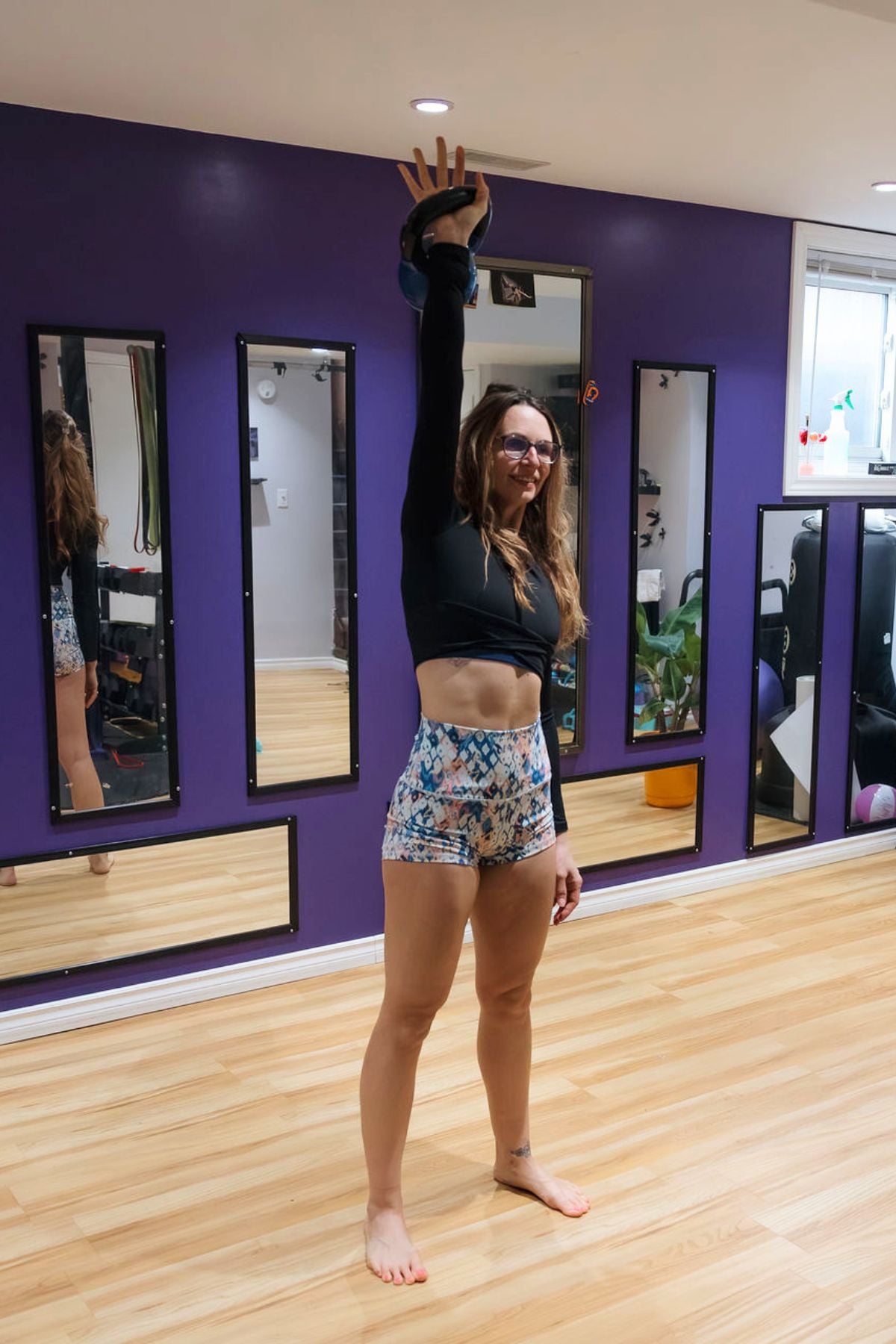
Single Arm Shoulder Press
As a mom, our shoulders get a workout each and every day! The truth is, just carrying your babes is a unilateral workout 😛
Chances are, you carry your babes on one side more often than the other. This is fine, except that it creates a bit of an imbalance. Make sure both of your shoulders are strong by performing this single-arm press.
This upper-body exercise helps keep your shoulders strong. It also requires a lot of stability to keep the body upright and in good posture. Remember, you can switch it up by doing this exercise seated or standing and with a resistance band or dumbbells.
Single Arm Row
Rowing should be a crucial part of ANY training program.
Single-arm rowing is even better Bentover rows, seated high rows and renegade rows are all amazing ways to row with just one arm. Check out more upper back exercises with bands to really nail down postural support.
Single Arm Chest Press
This can be done as a floor press (for more support) or as a flat back dumbbell press (more advanced).
Regardless, not allowing one arm to take over for the other in a press is difficult. It’s always a great way to make the shoulder stabilize.
Unilateral “Core” Exercises
Let’s not forget about direct core work! Remember, part of the job of the trunk muscles is to prevent movement, like in these plank alternatives for core strength. Training unilaterally reinforces that.
The exercises below challenge your body perfectly because they force the core to do its job. That said, technically, all unilateral exercises are core work! Each one requires more stability than a bilateral exercise, which makes your core work double time.
Single Arm Farmers Carry
One of the most functional ways to build core strength and stability (learn more about functional strength training). Think of it like carrying your kids, but done properly, without leaning.
Training it one side at a time helps improve balance and makes everyday movements easier. Traditional single-arm farmers carries are great. However, don’t forget about overhead carries or even bottom-up kettlebell walks.
Side Planks
A classic exercise that trains one part of your core at a time. This exercise comes with a ton of variations to keep it progressing. Add on:
- Abductions
- Hip dips
- A rotation with the upper arm
Pallof Press
This exercise should be a staple in all programs because it’s perfect for learning to stabilize.
It requires you to resist rotation in a variety of ways. You can do this exercise, standing, with a staggered stance, kneeling or even add it in to other exercises like the deadbug. Pallof presses are the foundation of STRENGTH.

How Often Should You Do Unilateral Exercises?
Most people benefit from including unilateral exercises 2–3 times per week.
You don’t need to overhaul your workouts, just swap in a few single-side movements or add them to your current routine. Consistency matters more than doing everything at once.
If you’re not sure how to structure your workouts or what to include, 6 Weeks to STRONG gives you a simple plan to follow, so you can build strength evenly (without guessing).

Common Questions About Unilateral Exercises
Unilateral exercises help improve sports performance, boost strength in the core muscles, correct muscle imbalances, and prevent injury. They’re a great addition to a workout program because they can be scaled to each individual level.
Focus on starting with your weaker side, but match the same reps on your stronger side. Overdoing it on one side can create new imbalances, consistency and control are what help even things out.
Bilateral exercises train both limbs at the same time, whereas unilateral exercises train only one. Think of a squat: a regular squat with both feet on the ground is a bilateral exercise. A unilateral variation would be a single-leg (or pistol) squat.



Ant says
Love how you show the exercise move/form and then show which part of the body that will help tone. I need to get back to working out. Your blog is pretty helpful.
fitasamamabear says
Thanks! I'm glad it was helpful!
Jenn says
These are great exercises! I have been getting back into it.
fitasamamabear says
Congrats on jumping back in!
Christine says
Man, I wish I had the drive like you to work out. I had a baby one year ago and my body does not look like yours and it because I do nothing! I better get it together! Thanks for sharing these exercises. I'll pin this and refer back to it for motivation.
fitasamamabear says
Everyone has different priorities so don't beat yourself up! I'm personally just a freakishly rigid person when it comes to my workouts but it wasn't always that way (it's been a very long journey: https://fitasamamabear.com/journey-to-health/). My advice is to pick a form of fitness you actually enjoy and start there. It takes a long time to create routine and it won't happen if you hate it but every little bit counts 🙂
Kimberly Hsieh says
Not a mom, but I will definitely do these exercises!
fitasamamabear says
I promise they work for non moms too 😀
Oh to Be a Muse says
These are all really good exercises, mom or no mom. I need to get back to the grind.
fitasamamabear says
They definitely work for non moms too! They rock because they get you strong!
Melissa says
Single leg glute bridges and single leg squats are two of my favourite exercises to include in a lower body workout. I definitely find that having to focus on one side at a time increases my mind-body connection as well, so I end up getting a better workout than if I were doing both sides at the same times. Thanks for sharing these. Great tips!
fitasamamabear says
I love it Melissa! You definitely need to focus SO much more when you're rocking unilateral exercises which is perfect because you contract the muscles more and thus see better results. Plus, it's easy for one side to take over for the other with bilateral exercises so it's nice to switch it up.
frankland says
great exercises, thank you for sharing!
fitasamamabear says
Thanks!