
The Bench Glute Bridge is a powerful way to train your glutes through a greater range of motion than floor work. If you’re unsure of the difference between a glute bridge and a hip thrust, it mainly comes down to positioning and range, something worth understanding as you progress.
Start by mastering glute engagement on the floor, then move to the bench version. From there, you can add variations to keep building strength.

A Quick Look At The Exercises
- 🎯 Best For: Building serious glute strength through a bigger range of motion than floor bridges
- 🏋️ Equipment Needed: A bench, couch, or sturdy chair (no machine required)
- 🧠 Key Distinction: A glute bridge is on the floor; a hip thrust is elevated — not the same move
- 🔁 How To Use This: Master the floor bridge first, then progress to the bench version
- 📈 Ways To Progress: Add dumbbells, a mini band, or a pause at the top
- ⭐ Why You'll Love It: The single most effective glute-building move you can do at home
SUMMARIZE & SAVE THIS CONTENT ON
If you’re learning how to grow your glutes (or just strengthen them), there is no better exercise than a bench glute bridge. Some people refer to it as an elevated hip bridge.
However, from here on out we’re going to call it what it is: a hip thrust.
This term was coined by Bret Contreras, who is, for all purposes, the Guru on Glutes.
Clarification: a glute bridge is done on the floor. A hip thrust is done with the back elevated on a bench.
The glute bridge and hip thrust come with a long list of variations (a lot of them used in my Glute Guide program), and though all three muscles are involved, the main muscle involved will be the gluteus maximus.
Jump To
Glute Bridge vs. Hip Thrust
Both glute bridges and hip thrusts target the glutes and are great for building strength.
Glute bridges are the simpler, more stable version, making them ideal for beginners. Hip thrusts use a greater range of motion, which can make them more challenging but also more effective for building strength over time.
Use both in your training for best results, they’re different, not better or worse.
Glute Activation: The How-To
Before learning the hip thrust, you want to make sure you can engage the glutes in the bridge position on the floor and then work on glute activation exercises.
The fun thing about glutes is that, when activated, they actually change shape! You can both feel and see the contraction.
To activate your glutes:
- Come into the starting position for a glute bridge: lie on the floor with the knees bent and feet hip-width or slightly more apart and close to the bum.
- Relax, inhale, and squeeze your glutes as you lift your hips opening up the hip flexors. This is called hip extension. You should feel the engagement.
- Place your hands on your buttocks and you should physically feel and see the contraction. The glutes should feel tight. Keep your hands there and release your hips back down towards the floor. The glutes will feel relaxed and squishy.
Try this with glute exercises like the glute bridge, clamshells, and lying abductions to really nail down how to activate your glutes.
How To Perform A Bench Glute Bridge
There are two ways to perform a hip thrust: the hinge method and the scoop method. However, the setup is the same.
Set it up: begin by placing your mid to upper back (right about the bra strap line) on a bench (or table, or couch).
Feet flat on the floor and hips dipped towards the floor. The feet will be slightly outside of your hips. At this bottom position, your knees should be slightly behind the bridge of your feet/your heels. Beginners will normally hook their elbows on the bench. This is fine so long as you don’t press into the bench with them for support.
Hip Hinge Method
In the starting position, begin to push through the heels, squeeze the glutes and lift the hips towards the ceiling.
As you do, the shins should come into a vertical position. Keep the upper back slightly rounded as you look forward and not straight up. Meaning, do not lay your upper back flat on the bench.
At the top of the movement, “lockout” with a big glute squeeze. Reverse the movement leading with the hips breaking and moving back toward the floor.
The Scoop Method
In the starting position, as you start to push through the heels, scoop your hips under (technically called a pelvic tilt but think of it as tucking your tail under your bum) as you lift towards the ceiling.
As you do, the shins should come into a vertical position. Keep the upper back slightly rounded as you look forward and not straight up. Meaning, do not lay your upper back flat on the bench.
At the top of the movement, “lockout” with a big glute squeeze. Reverse the movement by untucking the hips from the pelvic tilt as you start to lower them toward the floor.

DIY Hip Thrust At Home
Don't think you need a hip thrust machine or a workout bench to perform this move. All you need is an elevated surface (this also means it can be done anywhere). This is how most of my clients perform their hip thrusts in my Glute Guide for Moms program.
To do a hip thrust at home, use any of the following:
- Couch
- Table
- Chair (pressed against a wall for security)
- Wooden box or risers if you have them
Depending on the surface, it may be hard on your back. If this is the case, uses a folded yoga mat for some cushioning.
Glute Bridge Variations
Once you master the basic hip thrust (either method), you can work it into your glute training programs as is or with any of the glute variations below!
- Loaded with dumbbells or as a barbell hip thrust (learn how to get into a barbell hip thrust)
- With a mini loop above the knees, or a double-banded bridge
- By adding a three-second pause at the top (learn more about pause reps)
- Playing around with a wider versus a narrow stance
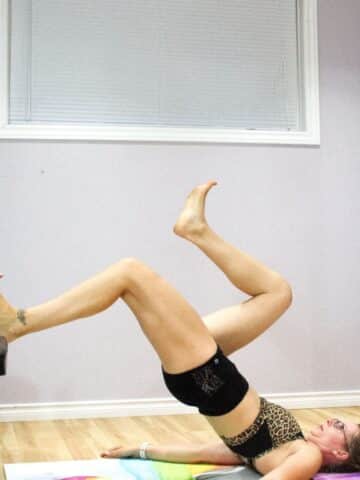
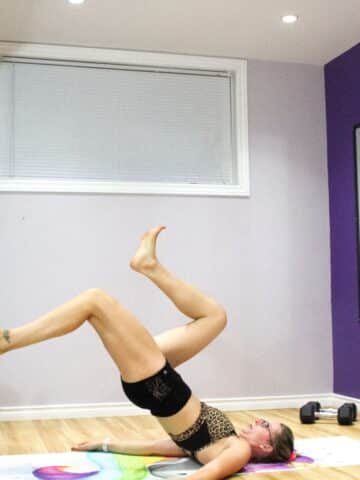
- Making it a single-leg glute bridge
More Practical Tips To Get You Fit
If you want to learn more about growing the glutes and getting fit at home, check out the blog posts below!
Want a simple plan to actually build stronger glutes? My Strong Glutes For Busy Moms guide walks you through exactly what to do at home—no guesswork, just results.
Bench Glute Bridge FAQs
Begin by sitting on the floor with your back against a bench, your legs out straight, and the loaded barbell by your feet. Roll the barbell over the legs so that it rests on your hip flexors. Hook your elbows onto the bench and bring your heels in as close to your bum as possible. Push your bum off the ground so that the upper to mid back rests against the bench. Bring your heels just in front of your knees and keep a rounded upper back, thrust the hips upward with the bar. Lock out the glutes and return toward the floor. Here is a great breakdown of a barbell hip thrust: https://www.youtube.com/watch?v=h4AphR3vhpg
The glute bridge is the basic movement of the hip thrust. Both exercises target the glutes and can build the glutes. However, because hip thrusts are done on a bench, they target the glutes with a greater range of motion. The bigger range of motion means that hip thrusts are an awesome way to build strength, power, and grow muscle.
If you're going to do glute bridges every day, you'll want to vary the load (weight) you use as well as the repetitions you strive for. Keep in mind that glute bridges are only one fantastic exercise for the glutes and the gluteal muscles respond best to variety.



Leave a Reply