
Struggling with ab separation or a “mom pooch” that won’t go away? This Diastasis Recti Workout focuses on rebuilding your deep core, not doing more crunches. This quick, 10-minute routine uses simple, safe exercises to help you strengthen your core and start feeling like yourself again.
"This is such a helpful post! Wish I knew this when my daughter was born. I hope this reaches as many new mothers as possible!" - Rupali
A Quick Look At The Workout
- 💭Equipment: No Equipment
- ⏲️Duration: 10 minutes
- 📖 Warm up: Not necessary
- 📋Intensity: Very low-intensity, mostly floor work.
- 📖 Frequency: 3-4 days per week.
- ⭐ Muscles used: You'll be primarily focusing on the deep core muscles like the transverse abdominus, along with some supporting muscles in the upper and lower body.
SUMMARIZE & SAVE THIS CONTENT ON
Why Deep Core Exercises Matter
Diastasis recti is common after pregnancy, but that doesn’t mean you have to stay stuck with a weak core or “mom pooch.”
When your deep core isn’t functioning well, it can lead to back pain, difficulty lifting and twisting, and that disconnected feeling through your midsection (though there are many reasons for a mom pooch).
The fix isn’t more ab exercises, it’s learning to engage your deep core muscles, especially the transverse abdominis.
These muscles work with your pelvic floor to support your spine, manage pressure, and rebuild real strength for everyday life.
The good news? You can retrain them.
And if you’re not newly postpartum, here’s how to fix diastasis recti years later.
What Is Diastasis Recti?
Diastasis recti is when the abdominal muscles (the rectus abdominis) separate during pregnancy as your belly expands.
This separation can affect how your core functions, often leading to poor engagement and that “mom pouch” look postpartum.
You can learn how to test for diastasis at home here.
It can also impact your pelvic floor and overall core strength, but it’s important to know that you don’t need to “fix” the gap completely. The goal is to retrain your core to function properly again.
Which is exactly what I focus on in the 7-week Heal Your Core program.
You can learn how to test for diastasis at home here.
How To Heal Diastasis Recti With Exercise
Healing diastasis recti isn’t just about doing core exercises, it’s about how your body works together.
To properly engage your deep core, you also need good upper body mobility (especially through your shoulders and upper back). If those areas are stiff, it’s much harder to activate your core the right way.
That’s why the workout below focuses on both core engagement and overall movement.
Pair it with upper body mobility work, like these thoracic spine exercises or these corrective exercises for diastasis recti to get the best results.
Diastasis Recti Workout
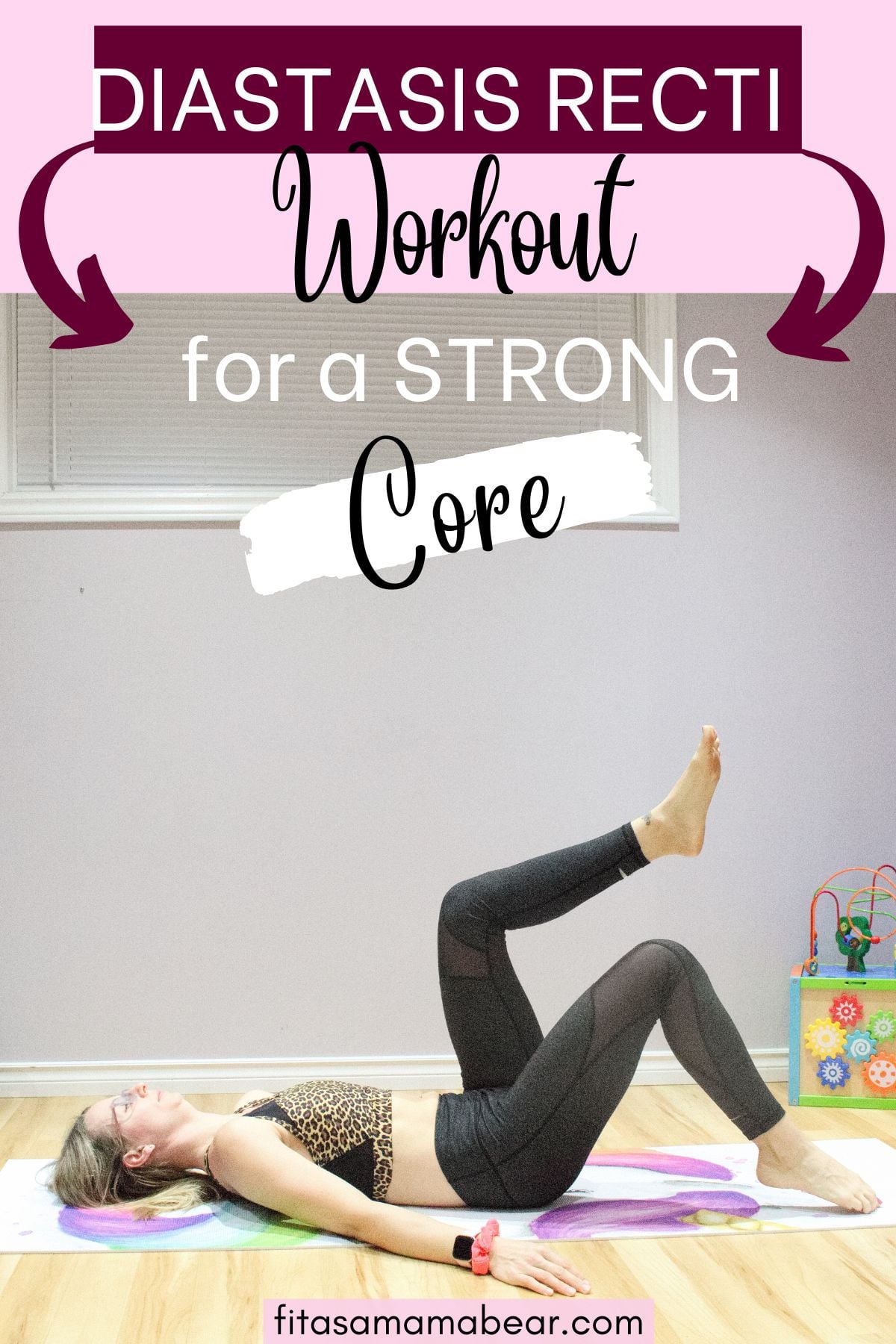
This diastasis recti workout makes use of the best core exercises for diastasis recti to help heal your core! It’s only 10 minutes long, which means you can get it done in between feedings or naps and requires no actual equipment.
Do this workout 4 times per week before moving on to bigger exercises or progressing the ones in the workout.
| Pullovers | 12 reps |
| Knee drops | 10 reps/side |
| Heel slides | 10 reps per side |
| Rest | 45 seconds for 3 rounds |
| Bridge With Adductor Squeeze | 12 reps |
| Toe Taps | 12 reps |
| Rest | 30 seconds for 2 rounds |
Complete the first circuit for 3 rounds, resting 45 seconds. Then complete the second circuit for 2 rounds, resting 30 seconds. Move slowly and focus on core engagement.
How To Perform Deep Core Exercises Properly
The core exercises for diastasis recti below can be done together or on their own.
Scroll down and learn how to perform them, practice, and really work on learning the abdominal engagement so that you can maximize your time using them. Pair them with hip exercises for pregnancy (even though you're not pregnant) and you'll get a ton of pelvic support back.
Or, check out the follow-along workout on YouTube to have me break them down.
Pullovers
- Lie on your back with knees bent
- Gently tuck your ribcage down
- Raise your arms up from the shoulders
- Keeping ribs down, extend arms overhead toward the floor
- Feel a stretch through the upper back and shoulders
- Engage your core to bring the arms back up
- Avoid arching your lower back throughout

Knee Drops
- Lie on your back with knees bent
- Tuck your ribs down and press your lower back into the floor
- Slowly drop one knee toward the floor
- Keep your hips steady and avoid arching your lower back
- Lower only as far as you can maintain control
- Use your core to bring the knee back to the start
- Repeat on the other side

Heel Slides
One of the best mom pooch exercises, but one that requires full focus.
- Lie on your back with knees bent
- Tuck your ribs down and gently bring hips toward ribs to engage your deep core
- Slowly slide one heel out until the leg is straight
- Keep hips level and core engaged throughout
- Pause briefly, then use your core to pull the leg back in
- Repeat on the other side

Bridge With Adductor Squeeze
- Lie on your back with knees bent close to your bum
- Place a ball, pillow, or block between your knees
- Tuck your ribs down and bring hips toward ribs so your lower back stays on the floor
- Press through your heels to lift your hips toward the ceiling
- Gently squeeze the ball to engage your inner thighs
- Lower back down with control and release the squeeze

Toe Taps
- Lie on your back with knees bent close to your bum
- Tuck your ribs down and bring hips toward ribs so your lower back stays on the floor
- Lift one leg, keeping the knee bent
- Maintain core engagement as you lower the toe toward the floor
- Tap lightly, then lift the leg back up from the hip
- Keep your core steady throughout (no arching)
- Complete all reps on one side, then switch

Best Core Exercises For Diastasis Recti
When it comes to healing diastasis recti, the goal is to focus on deep core engagement, not just movement.
Start by learning to properly engage your core and breathe, then build strength with exercises like:
- Block pullovers
- Leg drops
- Toe taps
- Heel slides
- Floor angels
- Glute bridge
- Pelvic tilt
Common Mistakes Most Moms Make
When it comes to healing diastasis recti, how you perform the exercises matters just as much as which ones you choose.
- Rushing through reps: These exercises should be slow and controlled. Speed usually means you’re losing proper core engagement.
- Jumping into crunches too soon: Traditional ab exercises can increase pressure and make things worse if your core isn’t ready.
- Not properly engaging your core: Going through the motions without activating your deep core won’t give you results.
- Ignoring your breathing: Proper “core and floor” breathing is key for managing pressure and supporting your core.
The small details make a big difference here, which is exactly why having guidance can help.
If you want step-by-step help with this, my Heal Your Core program walks you through how to properly engage your core, progress safely, and actually see results.
More Fitness Tips For Moms You'll Love
As you get started on your fitness journey, you'll also want to learn how to engage glutes to support your back and grab tips on how to exercise with a toddler for when you're at that stage.



Diastasis Recti Workouts FAQs
You can begin low-impact, diastasis recti exercise within the first few days of birth so long as the focus is on healing and not intensity. These exercises are mostly done lying down or sitting and should have a focus on breathing, alignment, and control. Avoid any traditional abdominal exercise (reverse crunches, planks, leg raises) in the days following birth.
Strategic diastasis recti exercise is a crucial element in repairing abdominal separation and the abdominal wall from pregnancy. Exercises specific to healing diastasis recti should focus on proper alignment, deep muscle activation, and combining muscle engagement with proper breathing techniques. Doing these exercises is a great way to begin to heal your diastasis.
Because exercises that focus on diastasis are often very low-impact, they can be done multiple times per week. The beginner exercises that focus on engagement and breathing work can even be done for a few minutes each day. Once you move on to the more advanced core work, you can work in a schedule of 3-4x per week.
Avoid exercises that create too much pressure on your core, like crunches, sit-ups, and full planks, especially early on. If you notice doming or bulging through your midsection, modify or skip the movement and focus on deep core engagement instead.



Rupali says
This is such a helpful post! Wish I knew this when my daughter was born. I hope this reaches as many new mothers as possible!
fitasamamabear says
It's just slowly getting to be mainstream thankfully!
Greta says
Love the ideas! I still struggle to lose weight after giving birth. I'll apply these ideas in my routines.
fitasamamabear says
It's a challenge to lose weight in the best of times let alone after a babe, if you ever need help just reach out!
Jennifer says
I just had a baby and am making this exercise a part of my getting back to normal body routine! Keep the tips and suggestions coming!
fitasamamabear says
Awm this makes me so happy! But also.. CONGRATS!!!! If you have any questions at all, shoot them over!
Liz says
My friend just had a baby so I'm going to send her all this info! I know she's going to find it so helpful. Thanks for sharing!
fitasamamabear says
You are SO sweet, I appreciate the share!
Sherry says
So many great tips to get me back to my pre-baby body. Thank you for all of the great exercises!
fitasamamabear says
Aw yay! If you have questions please don't hesitate to ask!