

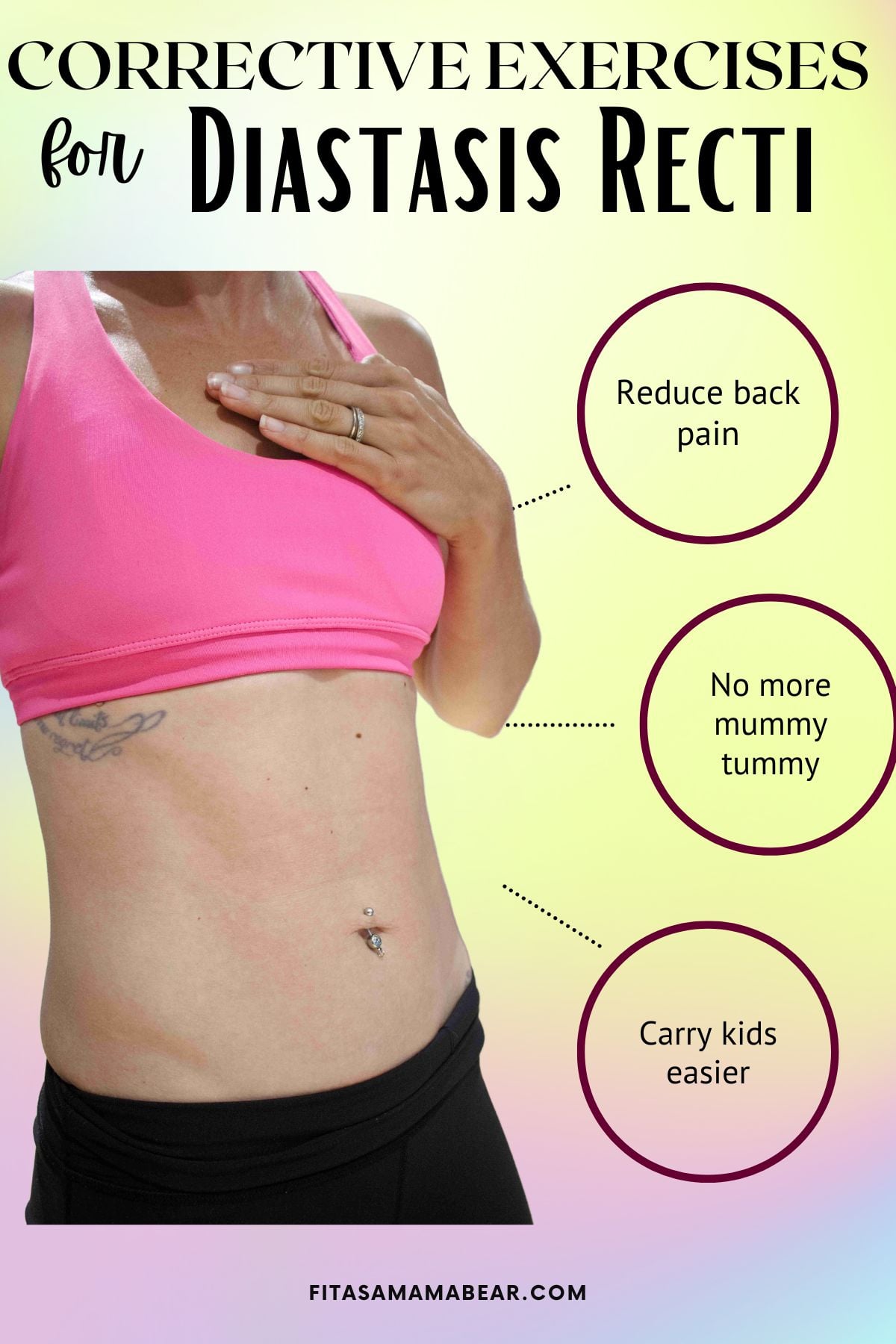
These Corrective Exercises for Diastasis Recti At Home focus on rebuilding your deep core muscles, not just “working your abs.” The goal is to restore tension, improve stability, and help your core function properly again.
A Quick Look At The Exercises
- 🎯 Best For: Rebuilding real core function and closing the gap, not just "working your abs"
- 💪 Exercises Included: 4 corrective moves focused on breath, control, and engagement
- 🏋️ Equipment Needed: None, or a mini loop band for one variation
- 🩺 Start Here: Master 360 breathing before adding any of these exercises
- 🔁 How To Use This: Practice each one individually first, then combine into a mini circuit
- ⭐ Why You'll Love It: A real path forward, even years postpartum
SUMMARIZE & SAVE THIS CONTENT ON
Most people think fixing diastasis recti means doing more ab exercises.
It doesn’t.
The real focus should be on rebuilding your deep core, learning how to properly engage your abs, managing pressure, and moving with control. That’s what actually helps close the gap and improve function. Exercises like breathing drills, heel slides, and glute bridges are effective because they train coordination and stability, not just strength.
Before jumping in, it’s worth understanding how everything works together. Learn how to engage your core properly and how to safely progress your diastasis recti workout, so you’re not accidentally making things worse. I go over all of this in my Heal Your Core program.
Jump To
- A Quick Look At The Exercises
- What is Diastasis Recti?
- What Makes An Exercise “Corrective” For Diastasis Recti?
- The Best Corrective Exercises For Diastasis Recti At Home
- Engagement Matters
- How To Know If You’re Doing The Exercises Correctly
- Ready To Actually Fix Your Core?
- More Postpartum Healing Tips
- Corrective Exercises For Diastasis Recti At Home FAQs
What is Diastasis Recti?
Diastasis recti is the separation of the abdominal muscles that happens when the connective tissue stretches, most commonly during pregnancy.
Common symptoms include poor core engagement, back pain, a protruding lower belly (“mom pooch”), leaking, and posture changes (know that there are more reasons you have a mom pouch than just diastasis).
It’s important to know that this isn’t about “fixing” your body, it’s about relearning how to engage your core properly and improving function over time. Many women see progress even years postpartum (how to heal diastasis recti years later).
If you’re not sure where you’re starting, learn how to test for diastasis recti at home. From there, focus on proper breathing and core engagement before moving into strengthening exercises.
What Makes An Exercise “Corrective” For Diastasis Recti?
Corrective exercises for diastasis recti aren’t just about the movement, they’re about how you breathe and control your core during the movement.
A big part of mummy tummy exercises is learning a proper 360 breath. Instead of sucking your stomach in, you want your core to expand through the ribs and back and contract naturally with your breath. This helps manage pressure and allows your deep core muscles to actually do their job.
Before jumping into exercises, practice this:
- Lie on your back with your head supported and your hands on your ribcage.
- As you inhale, you want to feel your ribcage expand under your hand and a breath go into the back of your body.
- As you exhale, think of "zippering up" from your pubic bone to your ribs.
Start with 10–15 controlled breaths daily. Once you can breathe properly and maintain that control, your exercises become far more effective, and actually corrective.
If an exercise causes strain, pressure, or visible separation, it’s not corrective. The goal is to restore function first, strength comes after.
The Best Corrective Exercises For Diastasis Recti At Home
The following exercises help heal diastasis recti by teaching you to engage the deep core muscles during movement and in different positions.
Practice them one at a time to master them, and then make them into a circuit to do a mini diastasis recti workout.
1. Long Lever Glute Bridge
- Lay on your back with your knees bent.
- Walk your feet out until your knees are wider than a 90-degree angle.
- Posteriorly tilt the pelvis, press into the heels, and lift your bum off the floor.
- Pause and release the engagement to lower back to the ground.
Reps: 10-15 repetitions

2. Supine Marches
- Lay on the ground with the knees bent and the heels close to your bum.
- Lift the upper back off the floor slightly and feel the lower back press into the floor.
- Use the lower abs to slowly raise one foot off the floor and lower it.
- Repeat on the other foot and begin marching slowly.
Reps: 30 seconds

3. Elevated Mountain Climbers
You need a mini loop for best results on this one though it can be done with just your bodyweight as well.
- Using a couch, table or bench come into a plank position with the mini loop around your feet.
- As you “tuck your tail under” bring one foot in toward the bench against the band.
- Step it back to the starting position and repeat with the other foot. Begin alternating moving slowly.
Reps: 30 seconds.

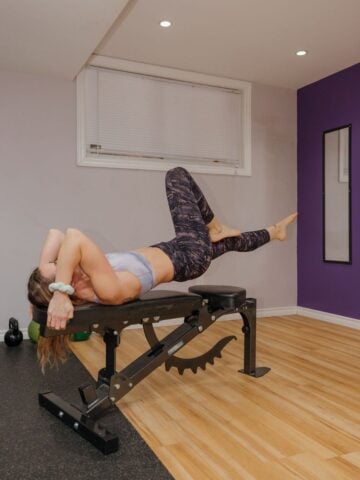
4. In & Outs
Grab a pair of socks and find a hardwood or tiled floor!
- Sit on your bum with your hands on the floor behind you. Keep the chest “tall” but don’t flare the ribs.
- The legs should be straight out from your hips.
- Slowly open the legs wide, close them, then pull the feet into your bum.
- Push the feet back out and repeat.
Reps: 30 seconds

Engagement Matters
It’s easy to “go through the motions” when it comes to deep core work. But that won’t get you anywhere.
Take the time to learn proper engagement and then move slowly. The best way to learn this is through pelvic tilts and deadbug variations.
Make each and every repetition count, knowing and feeling your lower abs work. I go over this a ton with clients in my Heal Your Core program and even help them troubleshoot.
How To Know If You’re Doing The Exercises Correctly
You’ll know your corrective exercises are working when your core feels controlled, not strained.
Watch for no doming or bulging through the midline, and focus on feeling your deep core engage rather than just your surface abs. Your breathing should stay steady and controlled throughout each rep, and the movement should feel stable and intentional, not rushed or forced.
Ready To Actually Fix Your Core?
If you’re feeling frustrated with your core or like things never quite “went back,” you’re not alone, and you’re not stuck.
Healing diastasis recti can happen at any stage postpartum, but it takes the right kind of training. That’s exactly what I walk you through in my Heal Your Core program, a simple, at-home plan designed to help you rebuild strength, improve function, and feel more confident again.
It’s just 10 minutes a day using minimal equipment, so it actually fits into real life.
More Postpartum Healing Tips
Your next steps should be to continue with core strengthening exercises (after you've mastered engagement).
You'll also want to start glute training at home so that you can carry kids more easily (check out the best mom workout to get you started, too!).



Corrective Exercises For Diastasis Recti At Home FAQs
Strategic diastasis recti exercise is a crucial element in repairing abdominal separation and the abdominal wall from pregnancy. Exercises specific to healing diastasis recti should focus on proper alignment, deep muscle activation, and combining muscle engagement with proper breathing techniques. Doing these exercises is a great way to begin to heal your diastasis.
Because exercises that focus on diastasis are often very low impact, they can be done multiple times per week. The beginner exercises that focus on engagement and breathing work can even be done for a few minutes each day. Once you move on to the more advanced core work, you can work in a schedule of 3-4x per week.
How long it takes to fix diastasis recti at home varies, but most women start to see improvement within a few weeks of consistent training. Full recovery can take a few months, depending on the severity and how consistently you’re doing corrective exercises.
Planks can be safe with diastasis, but only once you’ve rebuilt enough core control. If you notice doming, bulging, or pressure through your midline, you’re not ready yet, start with foundational exercises and progress to planks gradually.



Leave a Reply