


If you want effective Glute Training At Home, it’s about more than just doing bridges. Building strong glutes comes down to the right exercises, proper structure, and consistency, and you don’t need a gym to make it happen.
Here, you’ll learn how to train your glutes, how often to work them, and the best exercises to build strength, reduce pain, and see real results.

Glute training at home is about strengthening and building your glutes using simple, effective movements, without the gym.
While exercises like squats, deadlifts, and lunges are great, they’re only part of the picture. True glute training means learning how to engage your glutes properly and using a mix of movements to target them from different angles.
Jump To
- What Are The Glute Muscles?
- Benefits Of Strong Glutes
- The 3 Types of Glute Exercises You Need
- The Best Glute Exercises At Home
- How To Perform a Glute Bridge
- How To Structure Your Glute Training
- How To Grow Glutes
- How To Progress Your Workouts
- How Often To Train Glutes
- What Equipment Do You Need For Glute Training?
- Glute Workouts At Home
- Glute Training At Home FAQs
- Final Tips and Step-by-Step Guide
What Are The Glute Muscles?
The glutes are a series of three muscles that make up the buttocks (check out a breakdown of gluteal anatomy). Broken down, these muscles are the gluteus maximus (the largest part of your bum), the gluteus minimus (on your outer hip), and the gluteus medius (just above the hip and is over top of the minimus).
Though there are three muscles, they all work together to bring you a variety of functions:
- Hip extension (think bridges or a barbell hip thrust)
- Hip abduction (taking your leg away from your body to the side)
- Hip external rotation (turning your leg outwards)
Every glute exercise you use will target all of the muscles. However, it is possible to place extra emphasis on one over the other.
For example, glute bridges will target more of the gluteus maximus muscle whereas abductions will target more of the gluteus medius and gluteus minimus. Check out these wicked exercises for the gluteus Maximus and these gluteus minimus exercises.
Benefits Of Strong Glutes
The glutes do more than just fill out leggings; they support your back, knees, posture, and daily movement. But thanks to all the sitting we do, they often stop firing properly.
That’s why step one in any glute workout plan is learning how to activate your glutes (learning to hip hinge helps too).
Strong glutes mean:
- Less back and knee pain
- Better posture and performance (running, jumping, lifting)
- Easier parenting tasks (hello, toddler squats)
- Less pregnancy-related pain (see hip strengthening exercises for pregnancy)
To train glutes effectively, you need good hip mobility and full range of motion. It’s not just about the booty burn, it’s about building strength that prevents injury. Learn more about the glute exercise benefits.
Hack: Want to skip the guess-work? Check out the Glute Training E-book. A 25-page guide that gives you the exact glute workouts I use with clients.
The 3 Types of Glute Exercises You Need
Your glutes respond best to variety, which means training them through different movement patterns, loads, and rep ranges. To see real results, your workouts should include all three of these categories:
- Hip hinge movements (RDLs, glute bridges)
- Squat and lunge patterns (quads + glutes)
- Abduction exercises (targeting the side glutes)
While banded exercises are great for activation and volume (check out this banded glute workout), adding resistance over time is key if you want to build strength and muscle.
The Best Glute Exercises At Home
The best glute exercises at home are the ones that target your glutes from multiple angles while allowing you to build strength over time. By combining different movement patterns, you can train your glutes effectively
- Glute bridges (and all the bridge variations)
- The hip thrust
- Quadruped hip extensions
- Extended range hip abductions
- Posterior pelvic tilt
- Kickbacks
- Side lying hip raise
- Reverse plank
- Sumo walks
- Seated, forward leaning abductions
- Monster walks
- Deficit lunge
- American deadlift
- Band or cable pull through
- Reverse hyperextensions
- Curtsy lunges
- Crossack squats
Learn more about the best body weight glute exercises, glute isolation exercises, and glute activation exercises so that you can customize a program to maximize your training.
How To Perform a Glute Bridge
The glute bridge is a basic glute exercise that you'll need to master in order to reap the benefits of its variations.
- Begin in the starting position by lying on your back, bending your knees and bringing your heels close to your bum. Feet shoulder width apart roughly.
- Push through your heels and lift your hips by squeezing the glutes. Do not excessively arch the lower back. But aim for a full range of motion (get to the top!).
- Pause at the top for maximum glute squeeze before releasing the tension and bringing the hips back to the starting position.
Perform anywhere from 8-25 repetitions.
Pro Tip: A lot of people forget to release their glute muscles as they return to the starting position. It's hard to strengthen a muscle that's permanently "tight" and has a lackluster range of motion. So make sure to relax the glute muscles too!
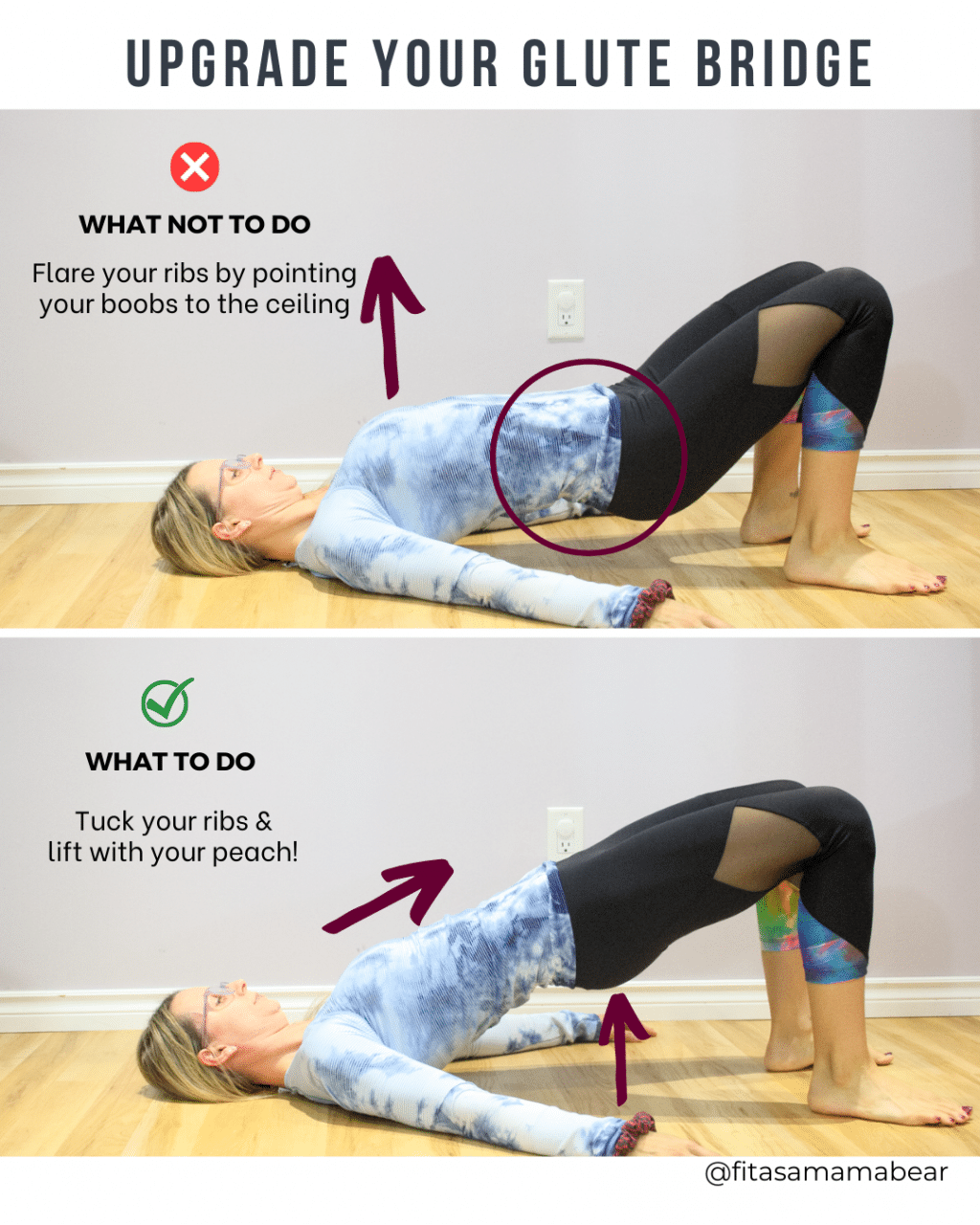
Glute Bridge Vs. Hip Thrust
Glute bridges and hip thrusts both build strong, powerful glutes, but they’re not the same.
Bridges are the foundation: simple, low-impact, and a great place to start. Hip thrusts move through a bigger range of motion, which can be more intense (and trickier to master), but also give you better gains. Learn more about the bench glute bridge.
How To Structure Your Glute Training
If you want results from glute training at home, you need more than just good exercises, you need a plan. A simple structure to follow:
- Train glutes 2–4 times per week
- Perform 4–6 exercises per session
- Include a mix of hip hinge, squat/lunge, and abduction movements
- Focus on progressive overload (increase weight, reps, or control over time)
How To Grow Glutes
If you want to grow your glutes, not just feel them during workouts, you’ll need more than just a few reps of banded kickbacks.
Real glute development comes from using different types of training stress:
- Tension (lifting weight or adding resistance)
- Control (slow, focused reps—especially on the way down)
- Burn (high-rep movements that make you feel the fire)
To keep your glutes responding, mix up how you train:
- One day, go heavy with fewer reps (think dumbbell hip thrusts).
- Another, slow it down with eccentric moves like deficit lunges.
- Then, toss in light but high-rep exercises like banded kickbacks or fire hydrants to finish it off.
And don’t forget: while the glute max gets most of the attention, training the glute med and min (your side glutes) is key for balance, stability, and a well-rounded shape. Learn step by step in how to grow glutes at home.
How To Progress Your Workouts
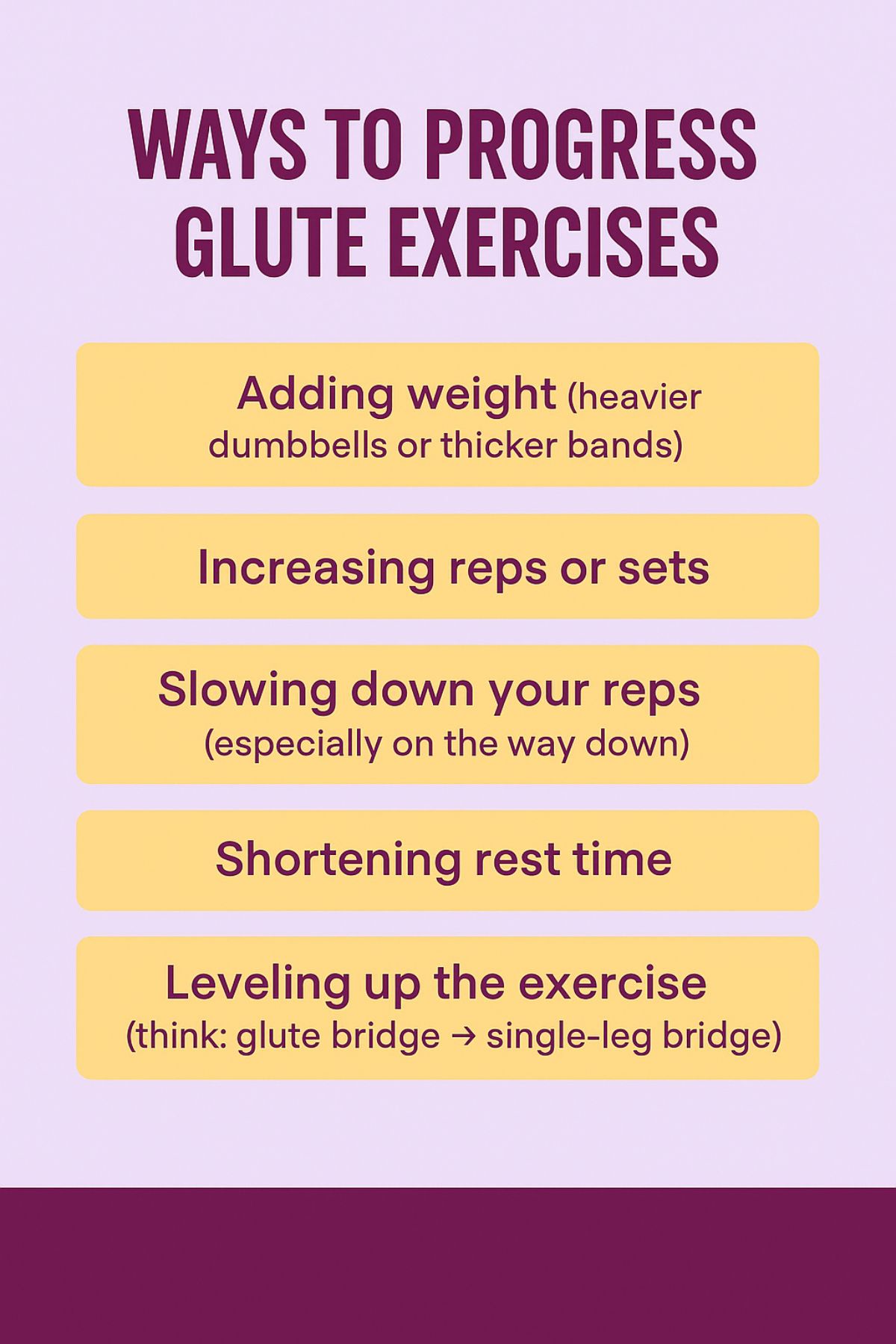
If you’ve been doing the same glute workout for months and wondering why your results have stalled, this is why. To actually build muscle (glutes included), your body needs a reason to adapt. That’s where progressive overload comes in.
It means consistently challenging your muscles a little more over time by:
- Adding weight (heavier dumbbells or thicker bands)
- Increasing reps or sets
- Slowing down your reps (especially on the way down)
- Shortening rest time
- Leveling up the exercise (think: glute bridge → single-leg bridge)
The glutes are a strong, stubborn muscle group, so if you want them to grow, you can’t just go through the motions. Learn 14 ways to ways to make workouts more intense at home.
How Often To Train Glutes
Glutes respond well to frequent, consistent training. Aim for:
- 2–4 workouts per week
- Either 2 longer sessions (20–30 min) or shorter 10-minute circuits added to your workouts
Start around 10–12 reps per exercise. When that feels easy, increase resistance, slow your tempo, or reduce rest time.
Of course, you can always skip the guessing and grab my Glute Guide, which has 10 weeks of done-for-you programs.

What Equipment Do You Need For Glute Training?
You don’t need equipment to train your glutes, but it definitely speeds up progress.
If you’re not using dumbbells or barbells, grab a mini loop and a couple of strength bands, they’re affordable, versatile, and perfect for home or travel. I recommend at least one mini loop and two different resistance bands to get started. These are some of the most cost-effective pieces of home training equipment.
Glute Workouts At Home
Below are a few of my favorite workouts you can do at home (but you can find more on the glutes playlist in my follow along workouts)
They’re done in under fifteen minutes and are a great way to begin building and strengthening your glutes (and reaping the benefits!).


Glute Training At Home FAQs
Most beginners skyrocket their results by simply learning to perform glute-dominant exercises correctly. From there, start by training glutes four times per week with a variety of exercises and loads. Then, make sure you’re eating enough to support muscle growth and continue to progressively train (keep challenging your glutes in new ways).
You’re not eating enough. In order for a muscle to grow, it needs fuel and nutrients (think building blocks). If you’re consistently in a calorie deficit or burning your calories with exercises like steady-state running, it’s hard for your glutes to grow past a certain point.
You want to use a variety of hip extension exercises like the glute bridge and hip thrust. Those two exercises can be done unilaterally (with one leg), with resistance, pauses, etc. Use multiple variations of those exercises and progressively load them (add tension) to really target your lower butt.
No! Although it’s not necessary to work your glutes every day, they do respond well to volume. So long as you’re not training heavy, compound lifts (like loaded barbell hip thrusts to failure) or eccentric exercises (deficit lunges) daily, your glutes will adjust to the stimulus.
Keep in mind though, that strong glutes and hip mobility go hand in hand to optimal performance.
Yes! If you want to boost performance, prevent injury, and reduce back pain, training glutes with glute-specific exercises multiple times per week is necessary.
The hip thrust is the king of all glute-based exercises. The target the glutes in horizontal hip hyperextension and are an amazing way to boost power and performance. There are a variety of hip thrust variations and all of them will be beneficial for your glutes.
Yes! Regardless of equipment, you can grow your glutes so long as you make good use of glute-specific exercises like hip thrusts, abductions, and bridge variations. The glutes respond well to variety so use multiple exercises and vary your sets, reps, and time under tension to see the best results.
Start with your mid to upper back on a bench or elevated surface. Dip the hips towards the ground with both feet flat on the floor. The shins should be angled backward a bit. Raise the left leg and place the weight into the right. Keep the hips square as you push through the foot and raise the hips toward the ceiling. Keep a straight left leg if it's comfortable, if not, bend the knee. At the top of the lockout position the upper back will be mostly flat on the bench and the hips extended. Release the glute squeeze and lower the hips back to the starting position.
Final Tips and Step-by-Step Guide
Remember that the most important part of training glutes is activation. Make sure you’re fully contracting the glutes on each and every rep. Once you engage glutes, follow the steps below to get stronger.
- Start with glute activation (e.g. clamshells, glute bridges)
- Incorporate 2–3 glute-focused exercises per session
- Use progressive overload: increase weight or reps weekly
- Train glutes 3–4x per week with variety
- Use glute stretches and proper recovery to maximize gains
Want glute workouts laid out for you—complete with reps, sets, and how to progress? Grab the Glute Training E-book for everything you need to build strength and feel powerful.


Leave a Reply